


TEst test
4 Key points on atopic dermatitis in dogs:
1
Signs
+
Itchiness,
licking,
biting,
and
redness
are
the
most
common
signs.
2
Causes
+
It
can
be
a
result
from
exposure
to
allergens
like
pollens,
mites,
molds,
and
human
dander.
Some
breeds
such
as
West
Highland
White
Terriers,
Golden
Retrievers,
and
Labrador
Retrievers
are
predisposed.
Additional
factors,
including
fleas,
can
intensify
inflammation
and
itching.
3
What to do
+
If
you
suspect
your
dog
may
have
allergies,
please
visit
your
veterinarian.
There
is
no
easy
test
for
atopic
dermatitis,
so
your
vet
may
perform
several
assessments
to
reach
a
diagnosis.
4
Treatment and prevention
+
Atopic
dermatitis
has
no
cure
and
requires
lifelong
management.
Your
vet
will
recommend
treatments
including
itch-relief
medication
and
topical
products
to
support
the
skin
barrier.
Atopic dermatitis is an allergic skin disease caused by environmental allergens. Similar to eczema in humans, it affects 10–15% of dogs. This lifelong condition must be well managed — otherwise, it can cause constant irritation, discomfort, and sleepless nights for both dogs and their owners.
What are the signs of atopic dermatitis in dogs?
Atopic dermatitis causes a wide range of symptoms. In most cases, the first signs appear between 6 months and 3 years of age. Some dogs show very mild signs, so owners may not realize their pet has an allergy. Others experience severe itching, self-trauma, and extensive skin damage.
Often (though not always), the pattern of skin inflammation gives your vet a clue that your pet may have an allergy.

Common locations of skin lesions in dogs with skin allergies

Dr Chiara Noli, Hair loss and inflammation on the thorax in an allergic dog.

Dr Chiara Noli, Inflammation and hair loss between the pads. This is a common feature in dog allergies.

Dr Susanne Ahman, Inflammed ear pinna. This is common in allergic dogs.
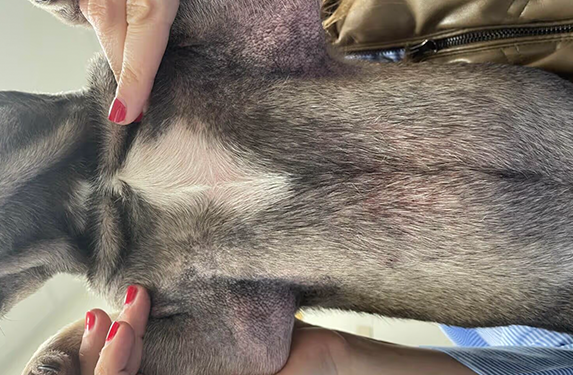
Redness, thickening (lichenfication) and skin hyperpigmentation in a dog. This is commonly seen notably in chronic allergies.
Common symptoms include:
Itchy skin (pruritis)
Scratching, licking, or biting specific areas (reddish-brown stains from saliva may appear)
Red, inflamed skin
Ear inflammation (otitis externa), which can lead to infection
If left untreated, the skin can become thickened and darker over time. Commonly affected areas include the face, ears, chin, armpits, belly, groin, and paws — particularly between the toes.
What triggers atopic dermatitis in dogs?

Many potential allergens
All known allergens causing atopic dermatitis are organic — that is, of natural origin. Household cleaning chemicals do not cause atopic dermatitis, however they may irritate the skin.
Pollens from trees, grasses and weeds – being seasonal, this may be the reason you notice your dog becomes itchier at certain times of the year
House dust mites and storage mites ; in this case, itch is not seasonal
Molds
Human dander

Dogs can react to several allergens at once. Sometimes, a single allergen may not trigger symptoms, but when combined with others, it exceeds the dog’s individual itch threshold.
Atopic dogs also have a defective skin barrier, which allows normal skin bacteria and yeast (like Malassezia) to penetrate and worsen inflammation. Parasites such as fleas can further aggravate the condition — a phenomenon known as the “summation of effects”, where multiple factors together intensify the itchiness.
Are certain breeds more affected by atopic dermatitis?
Because some breeds are more prone to atopic dermatitis, a genetic link is strongly suspected. Certain genetic makeups have weakened skin barriers, allowing allergens (like pollen) to cross the skin more easily.
Breeds predisposed include: West Highland White Terriers, Golden Retrievers, Labrador Retrievers, Shar Peis, Dalmatians, Boxers, Boston Terriers, Bulldogs (English and French), Bull Terriers, Pugs, German Shepherds, and Bichon Frises.
What to do in case of suspected atopic dermatitis?

Diagnosing allergies is relatively easy based on clinical signs, but identifying the cause can be challenging. Atopic dermatitis is a diagnosis by exclusion, meaning your vet must first rule out other skin diseases.
Treat secondary bacterial or yeast skin infections
If your dog has a secondary infection from scratching or biting, your vet will treat this first.
Rule out parasites
Your vet will check for fleas and mites, as flea allergy dermatitis (FAD) is common in dogs hypersensitive to flea saliva.
Explore the possibility of food allergies
Your dog might also be allergic to an ingredient in their diet. If suspected, your vet will recommend a food trial for at least 8 weeks. Improvement during the trial, followed by a relapse once allergens are reintroduced, confirms a food allergy.
Final step ; identify the allergens causing atopic dermatitis
Once other causes are excluded, your vet may confirm the diagnosis through allergy testing. Two common methods are:
Intradermal testing: injecting small amounts of potential allergens and observing for small, temporary hives.
Intradermal testing: injecting small amounts of potential allergens and observing for small, temporary hives.
Allergen-specific IgE serology: a blood test checking for antibodies to common allergens.
Allergen-specific IgE serology: a blood test checking for antibodies to common allergens.
Both tests can have limited accuracy, which is why they’re only performed after other causes are ruled out.
What is the treatment for atopic dermatitis in dogs?
There is no cure for atopic dermatitis. Treatment focuses on relieving itching and helping the body tolerate allergens. A multi-faceted approach is often required and will evolve over the dog’s lifetime.
Treatment typically includes:
Managing co-existing skin problems
Managing co-existing skin problems
Improving the skin barrier
Improving the skin barrier
Reducing allergen exposure
Reducing allergen exposure
Controlling the inflammatory response
Controlling the inflammatory response
Avoidance of triggers
If your dog’s allergen is known, avoid it as much as possible. This can be challenging since allergens like dust mites and pollens are widespread.
If your dog’s allergen is known, avoid it as much as possible. This can be challenging since allergens like dust mites and pollens are widespread.
For dust mites, remove carpets, vacuum often, and wash bedding regularly.
For dust mites, remove carpets, vacuum often, and wash bedding regularly.
For pollens, avoid walks during high pollen counts or in tall grass, and wipe or wash your dog afterward.
For pollens, avoid walks during high pollen counts or in tall grass, and wipe or wash your dog afterward.
Use monthly flea prevention without fail.
Use monthly flea prevention without fail.
Dietary management may help in cases with both food and environmental allergies, but must be done under veterinary supervision.
Dietary management may help in cases with both food and environmental allergies, but must be done under veterinary supervision.
Treat secondary skin infections
Bacteria and yeast that normally live on the skin often overgrow on atopic skin. If you see signs of infection, consult your vet. Topical antiseptic products like DOUXO® S3 PYO Shampoo, Mousse, or Pads (with 3% chlorhexidine* and 0.5% Ophytrium®) can help control bacteria and yeast such as Malassezia, soothe irritated skin, support the skin barrier — while hydrating the skin.
Apply topical products regularly to improve the skin barrier, soothe the irritated skin and support the skin microbiota

Atopic dermatitis damages the skin barrier, so ongoing support is essential. Topical products like the DOUXO® S3 CALM line help restore the three protective layers of the skin (mechanical, microbiological, and immunological). A good routine includes:
- Only 1 shampoo the first week to clean the coat and skin
- Leave-on mousse every 48–72 hours for continuous efficacy
For best results, use shampoo and mousse together for three weeks.
Reducing the inflammatory response and itch with drugs
If allergens can’t be avoided, medications may be needed to suppress inflammation and itching. Your vet may prescribe glucocorticoids (steroids) for short-term flare-ups or other immunomodulatory drugs to adjust immune response. Antihistamines can be added, although they are less effective alone in dogs than in humans.
Treating the cause
Allergen-specific immunotherapy (desensitization) involves regular exposure to diluted allergens to help the immune system adapt. About 50–80% of dogs show improvement, with reduced symptoms or less need for medication. This process takes up to 12 months, and your vet can advise if it’s suitable for your pet.
Learn more about



Find the right product for your pet
TAKE THE QUIZ
Safe for you and your pet

Recommended by veterinarians

Approved by pets and families

Is your dog’s skin very itchy or showing red spots? These are common symptoms of skin allergies or atopic dermatitis — both can be effectively managed with proper long-term care. Ask your vet for the best solution for your dog’s skin issues and learn more about DOUXO® S3 CALM, which helps soothe itchy, irritated, or allergic skin. This complete care routine includes soothing shampoos, and a leave-on mousse.
*Chlorhexidine can cause rare but serious allergic reactions in humans. If an allergic reaction occurs, discontinue use and seek immediate medical treatment. Do not use DOUXO® S3 PYO Mousse on cats. Do not use DOUXO® S3 PYO Pads between the toes of cats.